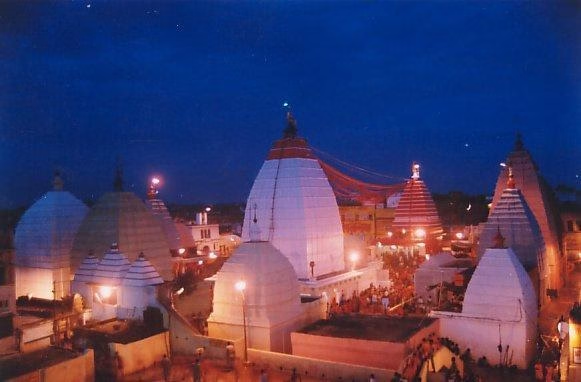
Nestled in the holy town of Deoghar, Jharkhand, the Baidyanath Temple (also known as Baidyanath Dham or Deoghar Jyotirlinga) stands as one of the most revered spiritual sites in Sanatana Dharma. It is one of the twelve sacred Jyotirlingas of Lord Shiva, representing the infinite nature of the supreme consciousness. The primary deity here is Baidyanath, the divine healer.
Phalaśruti: Why Visit Baidyanath?
According to ancient texts, a pilgrimage to this sacred shrine bestows specific spiritual benefits upon the devotee:
Removal of Sins: It is believed that praying at Baidyanath cleanses one of Bhuta-Pishacha (negative energies) and accumulated karmic debts.
Health & Healing: As “Baidya” means physician, devotees seek relief from chronic ailments and physical sufferings.
Ancestral Liberation (Pitra Moksha): Performing rituals here is said to grant salvation to departed ancestors.
Desire Fulfillment: The temple is locally revered as Kamana Lingam (The Lingam of Wishes). It is said that true devotion here fulfills the sincere desires of the heart.
Historical Origins & Scriptural Legend
The history of the Baidyanath Temple is a confluence of divine mythology and recorded history.
The Legend of Ravana and Varuna
Tradition holds that the demon king Ravana of Lanka was an ardent devotee of Lord Shiva. He performed severe penance on Mount Kailash to obtain the Jyotirlinga. Pleased, Shiva gifted him the lingam with a strict condition: Ravana must never place it on the ground until he reached Lanka. If he did, it would become permanently rooted to that spot.
The Devas (gods), fearing the loss of their power if the lingam reached Lanka, conspired to stop him. When Ravana reached the region of Deoghar, the god of winds, Varuna, entered his stomach, causing severe discomfort. Obliged to relieve himself, Ravana sought someone to hold the lingam. Lord Vishnu appeared as a Brahmin boy. As soon as Ravana handed over the lingam, the Brahmin placed it on the earth and vanished. Ravana tried to uproot the lingam with all his might but failed. He poured offerings of water from the Ganges on the lingam to atone for his failure, which is why the tank in the temple complex is known as Brahmkund or Hahikunda.
Historical Discovery
While the legend dates back to the Treta Yuga, historical records suggest the temple’s rediscovery in the early 16th century. According to temple records, the current structure was established in 1596 by a hunter named Baiju Nath (also known as Baidyanath), who rediscovered the lost lingam. Over time, the town came to be known as Deoghar (Abode of the Gods).
Architectural Marvels
The Baidyanath Temple complex is a masterpiece of ancient Indian temple architecture, primarily reflecting the Dravidian style (as indicated in historical data), though it also incorporates elements of the Nagara style common in Eastern India.
Structural Elements
The Sanctum (Garbhagriha): The central shrine houses the phallic Swayambhu (self-manifested) lingam, which is approximately 5 inches in diameter and rises from the ground.
The Shikhara: The temple features a towering spire (shikhara) adorned with intricate carvings.
The Mandapas: The complex includes various pillared halls used for congregational worship. Notably, the Rangamandapa features artistic stone carvings depicting mythological scenes.
Gold Vessels: The temple is famous for its golden umbrella (Chhatra) and gold vessels used in worship, donated by royalty and wealthy devotees over centuries.
Darshan & Ritual Logistics (2026 Update)
Planning your visit requires attention to the strict schedule of rituals followed at the temple. Below are the standard timings; please verify locally during festivals.
Daily Darshan Timings
Time Slot
Activity
03:00 AM – 04:00 AM
Morning Puja (Parvata Puja)
04:00 AM – 06:00 AM
General Darshan Opens
06:00 AM – 07:00 AM
Phala Arati / Bal Bhog
11:00 AM – 12:30 PM
Maha Aarti & Midday Puja (Best for ritual offerings)
Devotees can book specific Sevas (ritual services) in advance. The temple administration facilitates online booking for convenience.
Abhishekam: Ritual bathing of the Jyotirlinga with water, milk, honey, and ghee. (Timing: 6:00 AM – 8:00 AM).
Archana: Recitation of hymns and names of the deity. Can be performed individually or for family.
Q-Platform Darshan: A paid, faster line for darshan during peak hours.
How to Book: Visit the official Jharkhand Temple Committee website (jtdc.in) for the 2026 online portal. Register with your mobile number and Aadhaar details for secure booking.
Major Festivals in 2026
Shivaratri (Feb 26, 2026): The temple is illuminated with millions of earthen lamps. Shiv Baraat (wedding procession of Shiva) is a major highlight.
Sravana Month (July 14 – Aug 12, 2026): The busiest period. Mondays (Sombar) see massive footfall of Kanwariyas carrying Ganga water.
Maha Shivaratri: Continuous chanting and night-long vigils.
Practical Visitor Guidance
To ensure a smooth and respectful darshan, adhere to the following guidelines:
Dress Code: Traditional attire is recommended. Men should wear Dhoti/Kurta or formal trousers with a full-sleeve shirt. Women should wear Saree, Salwar Kameez, or Kurti. Avoid shorts, torn jeans, and sleeveless tops.
Mobile & Lockers:Electronic devices are strictly prohibited inside the sanctum. Free locker facilities are available near the entrance (East Gate). It is advisable to carry minimal luggage.
Photography: Photography is banned inside the temple complex and inner courtyards to maintain sanctity. Security will strictly enforce this.
Accessibility: The temple ground floor is accessible, but the inner sanctum has narrow passages and steps. Wheelchair access is limited to the outer courtyards.
Crowd Management Tips
Best Hours: For a peaceful darshan, visit between 2:00 PM and 4:00 PM when the crowds are thinner due to the midday break, or immediately after the morning Aarti (before 8:00 AM).
Seasonal Advice:
Summer (April-June): Jharkhand gets very hot. Carry a water bottle and wear a hat. Note: Plastic bottles are banned in the inner complex; carry a reusable steel/thermos flask.
Monsoon (July-Sept): Roads can be slippery due to heavy rain and Kanwariya footfall. Wear rubber sandals with good grip.
Pilgrimage Connectivity
How to Reach
Deoghar is well-connected by air, rail, and road. The temple is centrally located in the town.
By Air: The nearest airport is Deoghar International Airport (DHH), inaugurated recently, located approximately 5 km from the temple. Alternatively, Birsa Munda Airport, Ranchi (150 km) is a major hub.
By Rail:Deoghar Railway Station is the primary station, situated just 1 km from the temple (approx. 10-minute walk or auto-rickshaw). Special express trains run from Delhi, Kolkata, and Patna during festivals.
By Road: Deoghar is connected via National Highway NH-2. Frequent state transport buses and private taxis are available from Dumka (60 km), Ranchi (150 km), and Patna (250 km).
A visit to Baidyanath is often combined with nearby spiritual destinations to complete the Trayodashi circuit:
Trikut Pahar (Trikut Falls): Located 8 km from Deoghar, this scenic hill is home to the Trikuteshwar Mahadev. It is a popular trekking spot with a ropeway facility.
Naulakha Temple: Situated 1.5 km from Baidyanath, this temple resembles the famous Ramakrishna Temple in Belur Math and houses Radha-Krishna idols.
Basukinath Temple: Located 25 km from Deoghar, this is another ancient Shiva temple. Pilgrims often visit both Baidyanath and Basukinath in a single day (tradition dictates visiting Basukinath first).
Frequently Asked Questions (FAQ)
1. Is there a VIP darshan entry at Baidyanath Temple?
Yes, the temple administration provides a paid “Q-Platform” ticket (usually around ₹100–₹150) for a faster darshan queue. However, during peak festivals like Shivaratri or Sravana, even VIP tickets may require significant waiting time. VIP passes are issued at the counter near the temple gate on a first-come, first-served basis.
2. Can I carry Prasad inside the temple?
Homemade Prasad (sweets/fruits) is generally allowed in the outer premises but is restricted in the inner sanctum. However, the official temple counter inside the complex sells authorized Prasad (Roli-Akshat) which you can offer to the deity during darshan. Banned items include leather goods and tobacco products.
3. What is the significance of the water (Ganga Jal) available here?
The temple tank, known as Brahmkund, is located just opposite the main entrance. It is believed that the water here is holy Ganga Jal that Ravana poured on the Lingam. Devotees collect this water for rituals, though it is now managed for purity.
4. Is there a cloakroom facility?
Yes, free cloakrooms are available at the North and East gates. You must deposit mobile phones, cameras, and leather bags here. Tokens are provided for retrieval.
5. What are the dates for the Sravana Sombar Mela in 2026?
The Sravana month begins on July 14, 2026. The Mondays (Sombar) during this month—July 14, 21, and 28—are designated as holy days. The temple remains open 24 hours on these days, with special security deployment.
In the heart of Kashi, the eternal city of Lord Shiva, where the Ganges flows with celestial grace, stands the Shri Kaamkoteeshwar Mandir. This sacred Sannidhi is not merely a temple but a profound spiritual bridge between the Northern…
ओ सांवरे तूने ही मुझको संभाला – A Prayer to Shyam Origin & Spiritual Essence Why This Bhajan Resonates Devotees chant this when overwhelmed by life’s storms—the refrain ‘तूने ही मुझको संभाला’ is the soul’s sigh of relief: “You…
कथा ये है महाराज मेरे की छत्रपति संभाजी महाराज – A Prayer to Chhatrapati Sambhaji Maharaj Origin & Spiritual Essence Why This Bhajan Resonates Devotees chant this when their spirit feels tested—its powerful refrain “महाराज मेरे” is a soul’s…
The Rigveda is the oldest surviving scripture of humanity and the foundational text of Sanātana Dharma. For serious students, scholars, UPSC aspirants studying ancient Indian history, Sanskrit learners, and spiritual seekers, a precise and grammatically structured translation is indispensable.…
आना भी अकेला है जाना भी अकेला है – A Prayer to the Divine Witness Origin & Spiritual Essence Why This Bhajan Resonates Devotees turn to this bhajan in moments of deep reflection—when life’s attachments begin to ache. The…
माता शेरावाली के द्वार जो भी जाता है – A Prayer to Maa Sherawali Origin & Spiritual Essence Why This Bhajan Resonates Devotees turn to this bhajan in times of fear or uncertainty—its promise that no one leaves Maa’s…
मार लेना सपणी उबार लेणा भवरा – A Prayer to the Divine Beloved Origin & Spiritual Essence Why This Bhajan Resonates Devotees chant this in moments of deep vulnerability—its cry of “मार लेना सपणी, उबार लेणा भवरा” is the…
हमें श्याम सुंदर भरोसा तुम्हारा – A Prayer to Shyam Sundar Origin & Spiritual Essence Why This Bhajan Resonates Devotees chant this when feeling alone—its refrain ‘de do sahara’ is the soul’s cry for divine support. Lyrics in Hindi…
Mere Satguru Ne Di Thi Davai: Invoking the Guru’s Liberating Wisdom This soul-stirring bhajan venerates the Satguru (True Spiritual Master) as the divine physician who dispenses the only remedy for life’s deepest sufferings. Composed by Sant Karmaveer Tufani, it…
जन्म दियो थारी माँ दुख देखियो (Maa’s Grief Upon Birthing You) This soul-stirring Chetavani Bhajan (admonitory hymn) is addressed to the Divine Mother (Maa) – a call for repentance when children forget their filial duties in the dark age…