
Contents
- 1 The Divine Heights of Chotila: A Definitive Pilgrimage Guide to Chamunda Mandir
The Divine Heights of Chotila: A Definitive Pilgrimage Guide to Chamunda Mandir
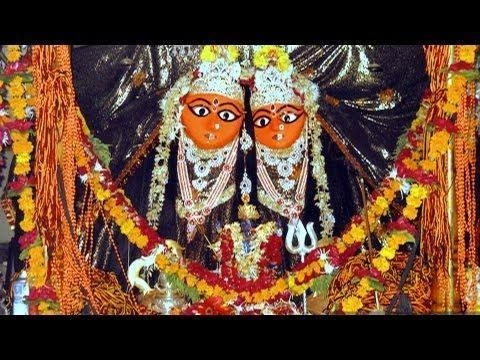
Nestled atop the imposing Chotila Hill in the Surendranagar district of Gujarat, the Chamunda Mandir stands as a beacon of Shakti (Divine Energy). For devotees seeking the blessings of Goddess Chamunda—the fierce yet benevolent form of Durga—this temple is not just a destination but a spiritual ascension.
Introduction & Spiritual Essence
The primary deity of this sacred site is Chamunda Mata, a fierce incarnation of Goddess Durga. In local folklore and devotion, she is often referred to as Chamunda Maa or Chotila Mata. The temple houses a Swayambhu (self-manifested) idol of the Goddess, radiating immense spiritual energy.
Phalaśruti: Why Visit?
According to the Phalaśruti (scriptural benefits) associated with Chamunda, devotees believe that a pilgrimage here offers profound protection from evil forces and negative energies.
- Ancestral Liberation: It is believed that performing rituals here helps cleanse ancestral karma, offering peace to departed souls.
- Protection from Black Magic: Chamunda is the slayer of demons; devotees visit to overcome obstacles caused by malefic planetary alignments.
- Fulfillment of Wishes: Unmarried women often pray here for a suitable match, while others seek relief from chronic illnesses.
Historical Origins & Scriptural Legend
The history of Chotila is a blend of mythological significance and medieval warfare.
Historical Evolution
Originally known as Chotgadh, the hill fortress has been a strategic point since ancient times. Historically, it was a holding of the Sodha Parmars. In 1566 AD, the region was conquered by the Khachar Kathis, who made Chotila one of their principal seats. Many Kathis trace their lineage directly to the Chotila house. During the British Raj, Chotila served as the headquarters of an Agency Thana.
Sthala Purana (Local Legend)
While historical records date the structure to the mid-16th century, the local legend (Sthala Purana) is far older. Tradition holds that this is the site where the right eye of Goddess Sati fell, making it a potent Shakti Peetha.
Another popular legend narrates the battle between Goddess Chamunda and the demons Shumbha and Nishumbha. Devotees believe the Goddess chose this serene hilltop to rest after slaying the demons, blessing the land with her eternal presence.
Architectural Marvels
The temple exemplifies the traditional Gujarati Temple Architecture, characterized by intricate carvings and a distinct white marble exterior.
Structure and Layout
The temple is situated at an elevation of 1,173 feet. The architecture features a tiered structure known as the Step-Pyramid style.
- The Steps (Sopan): The ascent to the sanctum is the temple’s defining feature. Devotees must climb 620 steps to reach the main shrine. This physical exertion is considered a penance (Tapasya) that purifies the mind before darshan.
- The Shikhara: The main spire rises above the sanctum sanctorum (Garbhagriha), topped by a golden Ghala (Kalash).
- Carvings: The walls and pillars are adorned with relief sculptures depicting scenes from the Puranas, particularly the triumph of Durga over Mahishasura.
- Surroundings: The hill offers a panoramic view of the surrounding plains, including the nearby Shri Vadar caves and the soda lakes of the region.
Darshan & Ritual Logistics
Strict adherence to ritual timings ensures a smooth flow of devotees. Below are the daily schedules and key sevas.
Daily Timings
| Session | Timing | Details |
|---|---|---|
| Morning Darshan | 05:00 AM – 12:00 PM | Best for avoiding crowd; cooler temperatures. |
| Afternoon Break | 12:00 PM – 03:00 PM | Temple remains closed for deity rest. |
| Evening Darshan | 03:00 PM – 07:30 PM | Includes Aarti and lighting of lamps. |
| Night Closing | 07:30 PM onwards | Shayan Darshan (resting period). |
Key Sevas and Online Booking
While many rituals are performed on-site, the temple trust has digitalized specific sevas for 2026.
- Abhishekam: Ritual bathing of the idol with milk, honey, and ghee. Time: 6:00 AM.
- Archana: Recitation of 108 names of Chamunda. Available throughout the day.
- Chunri Offering: Draping the deity in a red cloth, specifically on Tuesdays and Fridays.
- Online Booking: Devotees can book these sevas via the official Chamunda Devi Trust portal. Look for the “Book Seva” tab.
2026 Major Festival Dates
Planning your visit around these dates offers a vibrant cultural experience, though crowds are significantly higher.
- Navratri Festival:
- Chaitra Navratri: March 30 – April 7, 2026
- Shardiya Navratri: October 6 – October 14, 2026
- Deepavali (Diwali): October 20, 2026
- Maha Shivaratri: February 26, 2026
Practical Visitor Guidance
To ensure a safe and respectful visit, please adhere to the following guidelines.
Dress Code and Etiquette
- Attire: Traditional Indian wear is preferred. Western attire (shorts/skirts) is discouraged. Men should wear dhotis or trousers; women should wear sarees, salwar kameez, or covered dresses.
- Photography: Strictly prohibited inside the Garbhagriha (main sanctum). Photography is allowed in the outer mandapas and on the hilltop.
- Mobile Lockers: Shoes and leather items (bags, belts) must be deposited at the free locker facility at the base of the steps. Electronic items are discouraged inside the sanctum.
Crowd Management & Accessibility
- Best Hours: Visit between 6:00 AM – 9:00 AM or after 6:00 PM to avoid long queues.
- Accessibility: While the climb of 620 steps is mandatory for general darshan, a motorable road exists to the top for VIP access, senior citizens (above 70 years), and specially-abled devotees. A medical certificate is required for vehicle entry.
- Seasonal Advice: Summer (April–June) is extremely hot; carry a water bottle and a head covering. Monsoon (July–September) offers cool weather but slippery steps—proceed with caution.
Pilgrimage Connectivity
Chotila is strategically located near the major transport hubs of Saurashtra.
How to Reach
- By Air: The nearest airport is Rajkot International Airport (IXR), approximately 60 km away (1.5 hours by road).
- By Rail: The nearest railway station is Chotila (located at the foot of the hill), with direct trains from Ahmedabad and Rajkot. The major junction is Surendranagar Railway Station, 45 km away.
- By Road: Chotila lies on the Ahmedabad-Rajkot Highway (NH-47). State transport buses and private taxis are easily available from Rajkot, Ahmedabad, and Surendranagar.
Nearby Sacred Sites (Pilgrimage Circuit)
Extend your spiritual journey by visiting these nearby locations:
- Shri Umiya Mataji Temple (Unjha): Located about 90 km away, this is one of the most prominent temples for the Patidar community.
- Shri Matushri Vrundavan Sherba Bapa’s Temple (Miyani): A serene coastal temple complex roughly 100 km from Chotila.
- Sayla Jain Temple: Famous for its exquisite architecture, located 55 km away.
Frequently Asked Questions (FAQs)
Is there a VIP darshan entry available?
Yes, the temple trust provides a VIP entry lane for senior citizens, differently-abled persons, and those with vehicle permits. However, during Navratri, VIP privileges may be temporarily suspended to manage crowds.
Can I carry food inside the temple?
Outside food is not allowed inside the temple complex. However, there is a Bhojanalaya (community kitchen) at the base of the hill that offers affordable vegetarian meals (Prasad) to all devotees.
What is the contact number for the temple office?
The official contact number for the Shri Chamunda Devi Temple Trust is 08530007000. It is advisable to call during office hours (10:00 AM – 5:00 PM) for inquiries regarding bookings.
Is there accommodation available near the temple?
Yes, there are several Dharamshalas and guest houses run by the trust at the foot of the hill and on the hilltop. It is recommended to book in advance during festival seasons.
Are there ATMs available?
ATM facilities are available in Chotila town (base area), but cash availability can be intermittent during festivals. Digital payments (UPI) are widely accepted at the temple shops and for parking.


Recent Posts

Shri Kaamkoteeshwar Mandir, Varanasi – History & Significance
In the heart of Kashi, the eternal city of Lord Shiva, where the Ganges flows with celestial grace, stands the Shri Kaamkoteeshwar Mandir. This sacred Sannidhi is not merely a temple but a profound spiritual bridge between the Northern…

ओ सांवरे तूने ही मुझको संभाला – Lyrics & Meaning
ओ सांवरे तूने ही मुझको संभाला – A Prayer to Shyam Origin & Spiritual Essence Why This Bhajan Resonates Devotees chant this when overwhelmed by life’s storms—the refrain ‘तूने ही मुझको संभाला’ is the soul’s sigh of relief: “You…

कथा ये है महाराज मेरे की – Lyrics & Meaning
कथा ये है महाराज मेरे की छत्रपति संभाजी महाराज – A Prayer to Chhatrapati Sambhaji Maharaj Origin & Spiritual Essence Why This Bhajan Resonates Devotees chant this when their spirit feels tested—its powerful refrain “महाराज मेरे” is a soul’s…

Rigveda Samhita Yathartha Anuvada (ऋग्वेद संहिता यथार्थ अनुवाद) – Complete Set with Anvayartha & Hindi/English Translation
The Rigveda is the oldest surviving scripture of humanity and the foundational text of Sanātana Dharma. For serious students, scholars, UPSC aspirants studying ancient Indian history, Sanskrit learners, and spiritual seekers, a precise and grammatically structured translation is indispensable.…

आना भी अकेला है जाना भी अकेला है – Lyrics & Meaning | BharatTemples
आना भी अकेला है जाना भी अकेला है – A Prayer to the Divine Witness Origin & Spiritual Essence Why This Bhajan Resonates Devotees turn to this bhajan in moments of deep reflection—when life’s attachments begin to ache. The…

माता शेरावाली के द्वार जो भी जाता है – Lyrics & Meaning
माता शेरावाली के द्वार जो भी जाता है – A Prayer to Maa Sherawali Origin & Spiritual Essence Why This Bhajan Resonates Devotees turn to this bhajan in times of fear or uncertainty—its promise that no one leaves Maa’s…

मार लेना सपणी उबार लेणा भवरा – Lyrics & Meaning
मार लेना सपणी उबार लेणा भवरा – A Prayer to the Divine Beloved Origin & Spiritual Essence Why This Bhajan Resonates Devotees chant this in moments of deep vulnerability—its cry of “मार लेना सपणी, उबार लेणा भवरा” is the…

हमें श्याम सुंदर भरोसा तुम्हारा – Lyrics & Meaning
हमें श्याम सुंदर भरोसा तुम्हारा – A Prayer to Shyam Sundar Origin & Spiritual Essence Why This Bhajan Resonates Devotees chant this when feeling alone—its refrain ‘de do sahara’ is the soul’s cry for divine support. Lyrics in Hindi…

Mere Satguru Ne Di Thi Davai Lyrics in Hindi & Meaning
Mere Satguru Ne Di Thi Davai: Invoking the Guru’s Liberating Wisdom This soul-stirring bhajan venerates the Satguru (True Spiritual Master) as the divine physician who dispenses the only remedy for life’s deepest sufferings. Composed by Sant Karmaveer Tufani, it…

Janm Diyo Thari Maa Dukh Dekhiyo Lyrics in Hindi & Meaning
जन्म दियो थारी माँ दुख देखियो (Maa’s Grief Upon Birthing You) This soul-stirring Chetavani Bhajan (admonitory hymn) is addressed to the Divine Mother (Maa) – a call for repentance when children forget their filial duties in the dark age…