
Contents
- 1 Rudra Mahalaya Temple, Patan, Gujarat: A Complete Pilgrimage Guide
Rudra Mahalaya Temple, Patan, Gujarat: A Complete Pilgrimage Guide
Introduction & Spiritual Essence: The Resonance of Rudra
Nestled in the historic heart of the Patan district in Gujarat lies the Rudra Mahalaya Temple, a site that serves as a profound testament to architectural grandeur and unwavering devotion. Often referred to locally as Rudramal, this temple complex is not merely a structure of stone but a spiritual archive of the Chaulukya dynasty (Solankis). While the temple complex faces the challenges of history, its remaining structures—the majestic Toranas (gateways) and pillars—continue to resonate with the energy of Lord Shiva.
Primary Deity & Form: Historically dedicated to Lord Shiva, the temple housed a Swayambhu (self-manifested) Lingam. Even today, devotees visiting the remnants sense a powerful spiritual vibration, a lingering presence of the Rudra form of Shiva.
Historical Origins & Scriptural Legend
The timeline of Rudra Mahalaya is a saga of creation and resilience. According to temple records and historical inscriptions, the construction of this monumental site was initiated in 943 AD by King Mularaja, the founder of the Chaulukya dynasty. However, the temple remained incomplete until 1140 AD, when King Jayasimha Siddharaja consecrated the complex, transforming it into the principal spiritual hub of Siddhpur (historically known as Sristhal).
The Local Legend: Tradition holds that two Parmars from Malwa, Govinddas and Madhavdas, settled in the rush grass near the site. They discovered ancient temple foundations and a Shiva Linga. They claimed to witness heavenly beings at night, a divine revelation that inspired Siddharaja to complete the temple. An inscription in Mirat-i-Ahmadi notes that Siddharaja placed images of kings and a representation of himself in supplication, praying that even if the land were laid waste, this temple might remain.
History of Preservation: The site faced significant desecration. Alauddin Khalji’s general, Ulugh Khan, dismantled parts of the complex in 1296 AD. Later, Ahmed Shah I (1410–1414) converted the western portion into the congregational mosque (Jami Masjid). Despite this, two Toranas and four central pillars stand defiant, preserving the glory of the 12th century.
Architectural Marvels: Echoes of the Solankis
The Rudra Mahalaya is a masterpiece of the Nagara style of Hindu temple architecture, refined by the distinct aesthetics of the Gujarat Vastu Shastra. The original temple was a triple-storied structure with dimensions of approximately 300 by 230 feet.
Key Structural Elements:
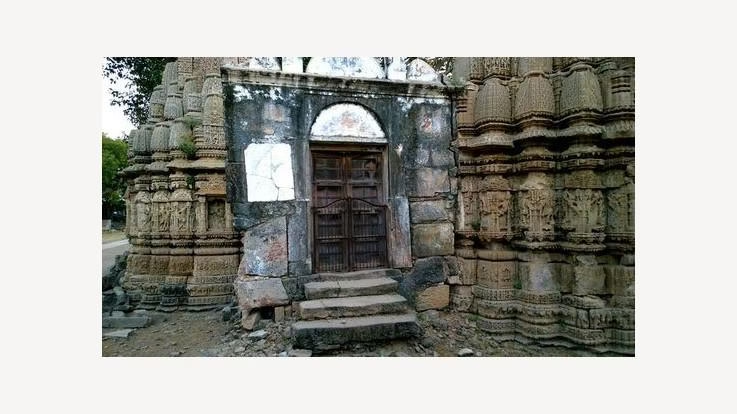
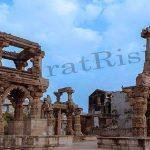
- The Toranas: The complex features two surviving porches (Toranas). The eastern gate, leading towards the Saraswati River, and the Kirti Torana in the north remain intact. These feature intricate carvings of Shiva Ganas, floral motifs, and celestial dancers.
- Pillar Halls: Originally, the temple housed 1,600 pillars. Today, a cluster of four main pillars remains in the central courtyard. These pillars are highly ornate, showcasing the Solanki mastery over stone carving.
- Sanctum & Mandapas: The sanctum was located to the west, flanked by a central Mandapa (hall) with porches on the eastern, northern, and southern wings.
- ASI Status: While not a UNESCO site, the Archaeological Survey of India (ASI) recognizes the remaining structures as protected monuments, preserving the legacy of this historic complex.
Darshan & Ritual Logistics
Visiting the Rudra Mahalaya today involves a spiritual walk through the archaeological remains. While the primary deity is no longer housed in the original sanctum due to historical events, devotees offer prayers at the reconstructed temple adjacent to the complex.
Daily Timings
Timings are generally consistent, though they may vary slightly during festivals.
| Session | Timings |
|---|---|
| Morning Darshan | 06:00 AM – 12:00 PM |
| Afternoon Break | 12:00 PM – 03:00 PM |
| Evening Darshan | 03:00 PM – 07:30 PM |
Key Sevas & Online Booking
Due to the historical nature of the site, standard temple Sevas are conducted at the adjacent temple trust office.
- Abhishekam: Performed daily at 8:00 AM and 6:00 PM.
- Rudra Paath/Archana: Available for specific devotee requests.
- Online Booking: While physical tickets are available, advance bookings for festivals are encouraged. Visit the official website of the Siddhpur Temple Trust (placeholder for link) or contact the trust office directly at 09722336217.
2026 Festival Calendar
Plan your visit around these significant dates for a heightened spiritual experience:
- Maha Shivratri: February 26, 2026 (Grand night vigil and special Abhishekam).
- Somvati Amavasya: January 30, 2026 (Highly auspicious for ancestral rituals).
- Shravan Month: July – August 2026 (Special timings for Monday darshans).
- Gujarat New Year (Bestu Varas): March 14, 2026.
Practical Visitor Guidance
Given the archaeological and religious sensitivity of Rudra Mahalaya, strict adherence to guidelines is required.
- Dress Code: Traditional attire is recommended. Men should wear dhoti or trousers with a shirt; women should wear saree, salwar kameez, or long skirts. Avoid shorts and sleeveless tops.
- Photography Rules: Photography is generally allowed in the outer courtyard and archaeological ruins. Restriction: Photography is strictly prohibited inside the main sanctum and the mosque area. Please respect the sanctity of the site.
- Mobile Lockers: As the site is a protected monument, large bags and luggage are discouraged. Small purse items are permitted.
- Crowd Management: The temple sees a surge during Mondays in Shravan and Mahashivratri. The best time to visit is early morning (6:00 AM – 8:00 AM) to avoid crowds.
- Seasonal Advice: Summers (April–June) in Patan are scorching; carry a water bottle and sun protection. Monsoon (July–September) offers a pleasant atmosphere, though the stone floors can be slippery.
Pilgrimage Connectivity
How to Reach:
- By Air: The nearest airport is Sardar Vallabhbhai Patel International Airport (AMD) in Ahmedabad, approximately 130 km away (3-hour drive).
- By Rail: The nearest major railway junction is Mehsana Junction (45 km). Local trains are available to Siddhpur station, which is just 1-2 km from the temple.
- By Road: Patan is located on the Ahmedabad – Radhanpur Highway (NH 64). State transport buses are frequent from Ahmedabad, Mehsana, and Patan.
Nearby Sacred Sites: Enhance your pilgrimage circuit by visiting:
- Rani ki Vav (Patan): A UNESCO World Heritage site, just a few kilometers from Rudra Mahalaya.
- Bala Hanuman Temple (Siddhpur): Known for the continuous chanting of “Sri Ram, Jai Ram, Jai Jai Ram” since 1964 (Guinness World Record).
- Modhera Sun Temple: Located about 60 km away, another masterpiece of Chaulukya architecture.
Visual Heritage
Explore the intricate carvings and surviving structures of the Rudra Mahalaya through our curated image collection.

Frequently Asked Questions (FAQ)
No, as it is an archaeological site managed by the ASI and the local trust, there is no specific VIP entry. However, disabled and elderly visitors are allowed closer access to the main courtyard assistance if required.
Yes, Rudrabhishekam can be performed at the designated prayer area near the complex. It is advisable to book the priest service one day in advance through the temple trust office.
Yes, the Rudra Mahalaya premises are generally safe during daylight hours. However, it is recommended to visit during morning or evening hours when other pilgrims are present.
The Toranas (ornate gateways) remaining at Rudra Mahalaya are architectural marvels of the 12th century. They served as entry points to the sanctum and symbolize the gateway between the earthly and divine realms. Their survival is a mark of resilience against historical invasions.
No, entry to the Rudra Mahalaya complex is free for all devotees and visitors. However, donations to the temple trust are welcomed and appreciated for the maintenance of the site.
Contact Details
Rudra Mahalaya Trust / Temple Office
Near Rang Fali, Ambavadi, Siddhpur, Patan District, Gujarat 384151
Phone: 09722336217
Recent Posts

Shri Kaamkoteeshwar Mandir, Varanasi – History & Significance
In the heart of Kashi, the eternal city of Lord Shiva, where the Ganges flows with celestial grace, stands the Shri Kaamkoteeshwar Mandir. This sacred Sannidhi is not merely a temple but a profound spiritual bridge between the Northern…

ओ सांवरे तूने ही मुझको संभाला – Lyrics & Meaning
ओ सांवरे तूने ही मुझको संभाला – A Prayer to Shyam Origin & Spiritual Essence Why This Bhajan Resonates Devotees chant this when overwhelmed by life’s storms—the refrain ‘तूने ही मुझको संभाला’ is the soul’s sigh of relief: “You…

कथा ये है महाराज मेरे की – Lyrics & Meaning
कथा ये है महाराज मेरे की छत्रपति संभाजी महाराज – A Prayer to Chhatrapati Sambhaji Maharaj Origin & Spiritual Essence Why This Bhajan Resonates Devotees chant this when their spirit feels tested—its powerful refrain “महाराज मेरे” is a soul’s…

Rigveda Samhita Yathartha Anuvada (ऋग्वेद संहिता यथार्थ अनुवाद) – Complete Set with Anvayartha & Hindi/English Translation
The Rigveda is the oldest surviving scripture of humanity and the foundational text of Sanātana Dharma. For serious students, scholars, UPSC aspirants studying ancient Indian history, Sanskrit learners, and spiritual seekers, a precise and grammatically structured translation is indispensable.…

आना भी अकेला है जाना भी अकेला है – Lyrics & Meaning | BharatTemples
आना भी अकेला है जाना भी अकेला है – A Prayer to the Divine Witness Origin & Spiritual Essence Why This Bhajan Resonates Devotees turn to this bhajan in moments of deep reflection—when life’s attachments begin to ache. The…

माता शेरावाली के द्वार जो भी जाता है – Lyrics & Meaning
माता शेरावाली के द्वार जो भी जाता है – A Prayer to Maa Sherawali Origin & Spiritual Essence Why This Bhajan Resonates Devotees turn to this bhajan in times of fear or uncertainty—its promise that no one leaves Maa’s…

मार लेना सपणी उबार लेणा भवरा – Lyrics & Meaning
मार लेना सपणी उबार लेणा भवरा – A Prayer to the Divine Beloved Origin & Spiritual Essence Why This Bhajan Resonates Devotees chant this in moments of deep vulnerability—its cry of “मार लेना सपणी, उबार लेणा भवरा” is the…

हमें श्याम सुंदर भरोसा तुम्हारा – Lyrics & Meaning
हमें श्याम सुंदर भरोसा तुम्हारा – A Prayer to Shyam Sundar Origin & Spiritual Essence Why This Bhajan Resonates Devotees chant this when feeling alone—its refrain ‘de do sahara’ is the soul’s cry for divine support. Lyrics in Hindi…

Mere Satguru Ne Di Thi Davai Lyrics in Hindi & Meaning
Mere Satguru Ne Di Thi Davai: Invoking the Guru’s Liberating Wisdom This soul-stirring bhajan venerates the Satguru (True Spiritual Master) as the divine physician who dispenses the only remedy for life’s deepest sufferings. Composed by Sant Karmaveer Tufani, it…

Janm Diyo Thari Maa Dukh Dekhiyo Lyrics in Hindi & Meaning
जन्म दियो थारी माँ दुख देखियो (Maa’s Grief Upon Birthing You) This soul-stirring Chetavani Bhajan (admonitory hymn) is addressed to the Divine Mother (Maa) – a call for repentance when children forget their filial duties in the dark age…