

Contents
- 1 Definitive Pilgrimage Guide: Konark Sun Temple, Odisha
Definitive Pilgrimage Guide: Konark Sun Temple, Odisha
As the Lead Heritage Architect for BharatTemples.com, I invite you to witness the architectural zenith of medieval India. The Konark Sun Temple, known locally as Surya Devalaya, stands as a testament to the devotion of the Eastern Ganga Dynasty and the artistic genius of Odisha’s stone craftsmen. This guide is engineered for the devotee and the historian alike, providing a respectful yet comprehensive pathway to experiencing this marvel of the ancient world.
Introduction & Spiritual Essence
Located in Konark, Puri district, this 13th-century marvel is dedicated to Surya, the Hindu Sun God. The temple is a Swayambhu (self-manifested) spiritual site, designed to capture the first rays of the rising sun.
- Primary Deity: Surya (Sun God). The sanctum once housed a 12-foot tall Nava-graha (nine planets) image of Surya.
- Alternate Names: The Black Pagoda (by European sailors), Konaditya, and Arka Kshetra.
- Form: The temple itself represents the chariot of Surya, pulled by seven horses, symbolizing the seven days of the week and the seven chakras.
Phalaśruti: The Benefits of Visitation
Devotees visit the Konark Sun Temple not merely for architectural wonder, but for spiritual healing. According to the Skanda Purana and local Brahma Purana traditions:
- Removal of Afflictions: Just as the mythological King Samba was cured of leprosy by Surya here, devotees suffering from prolonged illnesses or skin ailments perform Surya Namaskar at the Nata Mandir for relief.
- Ancestral Karmic Cleansing: Performing Maha Tarpanam (offering water to the Sun) at the Konark seashore (Chandrabhaga) is believed to liberate ancestors from the cycle of rebirth.
- Removal of Graha Doshas: Those facing astrological afflictions related to the Sun (malefic placement in birth chart) find solace through specific Archana rituals here.
Historical Origins & Scriptural Legend
The origins of the Konark Sun Temple are rooted in the golden age of the Eastern Ganga Dynasty.
- Builder: King Narasimhadeva I (also known as Narasingha Deva).
- Century: 13th Century CE (constructed circa 1250 CE).
- Duration: It took 12 years of intense labor by 1,200 artisans to complete this monolith.
Scriptural Legend (Sthala Purana): Tradition holds that the temple was built by Samba, the son of Lord Krishna and Jambavati. Cursed with leprosy due to a mistake by his father, Samba meditated here for 12 years. Pleased by his devotion, Surya granted him a cure. In gratitude, Samba constructed a temple for Surya, establishing the sanctity of this soil long before the Ganga Dynasty erected the current stone structure.
Architectural Marvels
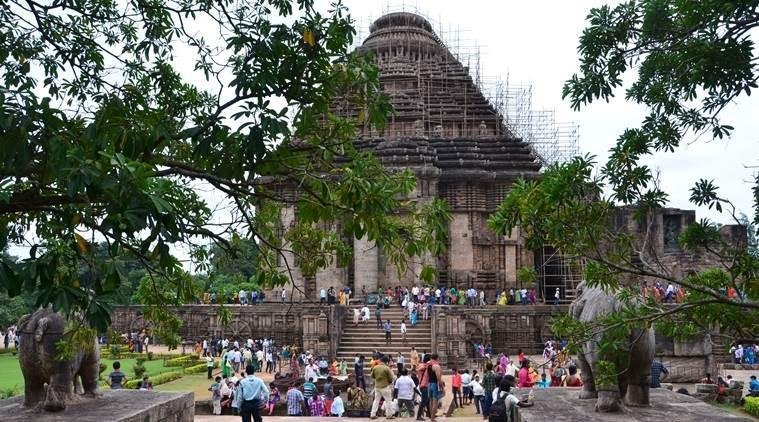
The Konark temple is the supreme example of Kalinga Architecture, a distinct regional style of Orissa. The temple is designed according to the principles of Vastu Shastra and Shilpa Sastra.
The Chariot Design
The temple is conceived as a colossal chariot of Surya.
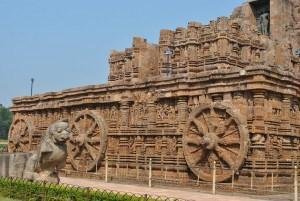
- Wheels: There are 12 pairs of elaborately carved stone wheels (approx. 12 feet in diameter), representing the 12 months of the Hindu calendar.
- Spokes: The spokes of the wheels contain intricate sundials that accurately tell the time of day based on the shadow cast.
- Horses: Seven horses (symbolizing the seven days of the week) pull the chariot towards the east, facing the rising sun.
Structural Elements
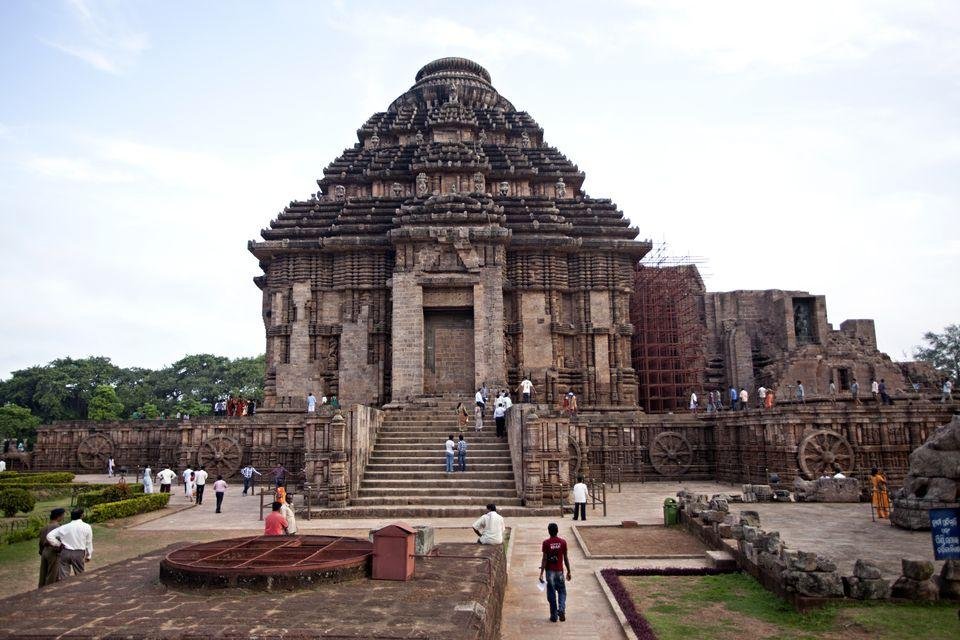
- Deul (Sanctum): The main Rekha Deul (towering shrine) rose 229 feet, though it collapsed in 1837.
- Jagamohana (Assembly Hall): The surviving pyramidal structure (128 feet high) with three tiers and sixPidahas (horizontal layers). It remains the focal point for Darshan.
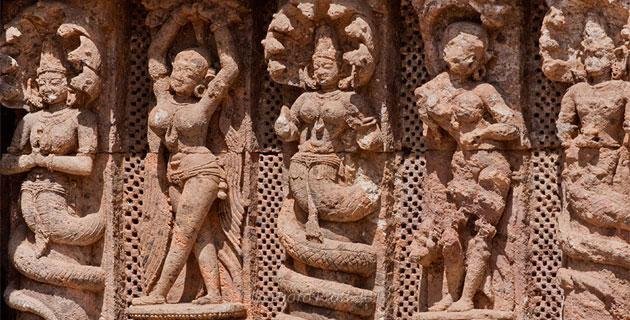
- Nata Mandir (Dance Hall): Located in front of the Jagamohana, this platform features relief sculptures depicting dancers in various poses.
- Materials: Built from Khondalite (ferrous sandstone), which weathers to a black hue over time, giving it the ‘Black Pagoda’ moniker.
UNESCO & ASI Status: Declared a UNESCO World Heritage Site in 1984. The Archaeological Survey of India (ASI) maintains strict preservation protocols due to the structure’s fragility.
Darshan & Ritual Logistics (2026 Schedule)
Currently, the inner sanctum is open for Darshan at specific intervals. While the central deity is no longer present in its original form, the energy of the Arka Kshetra remains potent through the architecture and the Nava Graha idols.
Daily Timings
Note: Timings are subject to change based on seasonal solar cycles and temple administration announcements.
| Session | Timing | Activity |
|---|---|---|
| Morning | 06:00 AM – 12:00 PM | Morning Puja & General Darshan |
| Afternoon | 12:00 PM – 03:00 PM | Closed (Rest Period) |
| Evening | 03:00 PM – 08:00 PM | Evening Arati & General Darshan |
Key Sevas and 2026 Festivals
- Maha Arati: Performed during sunrise and sunset. This is the primary ritual of light offering.
- Online Seva Booking: The temple facilitates Seva through the official ASI/State Tourism portal. Devotees can book Surya Arati passes online in advance to avoid queues.
Major Festival 2026:
- Chandrabhaga Mela (Konark Festival):
- Date: February 2026 (Specifically around the full moon day of the Hindu month of Magha).
- Significance: Celebrated on the banks of the Chandrabhaga River, 3 km from the temple. Thousands of devotees take a holy dip here.
- Makar Sankranti: January 14, 2026 (Celebrated as a major Sun festival).
Practical Visitor Guidance
To ensure a respectful and smooth visit, please adhere to the following guidelines curated for the 2026 pilgrim season.
Code of Conduct
- Dress Code: Traditional Indian attire is recommended. Men should wear Dhoti or full-length trousers; women should wear Saree or Salwar Kameez. Modest clothing is strictly enforced.
- Photography: Photography is permitted in the outer complex and gardens. Strictly prohibited inside the Jagamohana (sanctum) and near the ASI-protected delicate sculptures.
- Mobile Phones: Electronic devices are allowed but must be kept on silent mode. Use of tripods or drones requires prior ASI permission.
Crowd Management & Accessibility
- Best Hours to Visit: 6:00 AM (opening) offers the most serene atmosphere and best lighting for photography. Alternatively, 4:00 PM allows for witnessing the sunset against the chariot backdrop.
- Seasonal Advice:
- Summer (April-June): Temperatures can exceed 40°C. Carry water, wear a hat, and use sun protection. The stone floor becomes very hot.
- Monsoon (July-Sept): Slick surfaces. Wear rubber-soled sandals with good grip.
- Accessibility: The main path to the Jagamohana has ramps, though the terrain is uneven. Wheelchair access is limited to the outer courtyard. Mobile lockers are available near the ticket counter for storage of bags and electronics.
Pilgrimage Connectivity
How to Reach
The temple is located approximately 35 km from Puri and 60 km from Bhubaneswar on National Highway 16 (NH16), formerly NH5.
- Air: The nearest airport is Biju Patnaik International Airport (BBI) in Bhubaneswar (approx. 1 hour 15 mins drive).
- Rail: The nearest railway junction is Puri (PURI) (35 km). However, Bhubaneswar Railway Station (BBS) is the major hub connecting to all of India.
- Bus: AC and non-AC buses ply regularly between Puri, Bhubaneswar, and Konark. The Odisha State Road Transport Corporation (OSRTC) offers dedicated tourist packages.
Nearby Sacred Sites
Extend your pilgrimage to form a Pancha Tirtha circuit (Five Holy Sites) in Odisha:
- Jagannath Temple, Puri (35 km): One of the Char Dham sites, housing Lord Jagannath.
- Chilika Lake (Balugaon): Asia’s largest brackish water lagoon, home to the Balgopal Temple (Lord Krishna) on the island of Kalijai.
- Raghurajpur Artist Village (14 km): Not a temple, but a heritage crafts village where you can witness the traditional Pattachitra painting style.
Konark Temple is one of the famous Sun temples of Odisha. Konark Sun Temple is a 13th century Sun Temple (also known as the Black Pagoda), at Konark, in Odisha. It was constructed from oxidized and weathered ferruginous sandstone by King Narasimhadeva I (1238-1250 CE) of the Eastern Ganga Dynasty. The temple is an example of the Orissan architecture of the Ganga dynasty. The temple is one of the most renowned temples in India and is a World Heritage Site. It is one of the Seven Wonders of India (as per the poll collected by NDTV). Legend has it that the temple was constructed by Samba, the son of Lord Krishna. It is said that Samba was afflicted by leprosy, brought about by his father’s curse on him. After 12 years of penance, he was cured by Surya, the Sun God, in whose honor he built the magnificent Konark Sun Temple.
Contact Details
Official Address
Frequently Asked Questions (FAQ)
1. Is there a VIP or Express Darshan entry available?
Yes, the temple administration provides a ‘Quick Darshan’ lane for senior citizens and differently-abled pilgrims. A specific number of tokens are issued daily. For VIP passes, one must obtain permission from the ASI superintendent or the Odisha Tourism office in Bhubaneswar.
2. Are guided tours available at the temple complex?
Yes. The ASI has a trained guide system at the ticket counter. Audio guides are also available at the Odisha Tourism Information Centre located near the temple entrance. Hiring a guide is highly recommended to understand the intricate symbolism of the architecture.
3. What are the ticket prices for Indian and Foreign nationals?
As per the latest ASI guidelines (subject to revision in 2026):
- Indian Nationals: ₹40 per person.
- SAARC/BIMSTEC Nationals: ₹600 per person.
- Foreign Nationals: ₹600 per person.
4. Can I visit the temple at night?
The temple is open for a light and sound show in the evening (usually 7:00 PM to 8:00 PM), which narrates the history of Konark. However, physical entry to the sanctum and ruins is not allowed after the general closing time (8:00 PM).
5. Is non-vegetarian food allowed near the temple?
Konark is a holy site. Non-vegetarian food and alcohol are strictly prohibited within the temple premises and the surrounding town area. Several satvic restaurants are available nearby serving traditional Odia thalis.
Recent Posts

Shri Kaamkoteeshwar Mandir, Varanasi – History & Significance
In the heart of Kashi, the eternal city of Lord Shiva, where the Ganges flows with celestial grace, stands the Shri Kaamkoteeshwar Mandir. This sacred Sannidhi is not merely a temple but a profound spiritual bridge between the Northern…

ओ सांवरे तूने ही मुझको संभाला – Lyrics & Meaning
ओ सांवरे तूने ही मुझको संभाला – A Prayer to Shyam Origin & Spiritual Essence Why This Bhajan Resonates Devotees chant this when overwhelmed by life’s storms—the refrain ‘तूने ही मुझको संभाला’ is the soul’s sigh of relief: “You…

कथा ये है महाराज मेरे की – Lyrics & Meaning
कथा ये है महाराज मेरे की छत्रपति संभाजी महाराज – A Prayer to Chhatrapati Sambhaji Maharaj Origin & Spiritual Essence Why This Bhajan Resonates Devotees chant this when their spirit feels tested—its powerful refrain “महाराज मेरे” is a soul’s…

Rigveda Samhita Yathartha Anuvada (ऋग्वेद संहिता यथार्थ अनुवाद) – Complete Set with Anvayartha & Hindi/English Translation
The Rigveda is the oldest surviving scripture of humanity and the foundational text of Sanātana Dharma. For serious students, scholars, UPSC aspirants studying ancient Indian history, Sanskrit learners, and spiritual seekers, a precise and grammatically structured translation is indispensable.…

आना भी अकेला है जाना भी अकेला है – Lyrics & Meaning | BharatTemples
आना भी अकेला है जाना भी अकेला है – A Prayer to the Divine Witness Origin & Spiritual Essence Why This Bhajan Resonates Devotees turn to this bhajan in moments of deep reflection—when life’s attachments begin to ache. The…

माता शेरावाली के द्वार जो भी जाता है – Lyrics & Meaning
माता शेरावाली के द्वार जो भी जाता है – A Prayer to Maa Sherawali Origin & Spiritual Essence Why This Bhajan Resonates Devotees turn to this bhajan in times of fear or uncertainty—its promise that no one leaves Maa’s…

मार लेना सपणी उबार लेणा भवरा – Lyrics & Meaning
मार लेना सपणी उबार लेणा भवरा – A Prayer to the Divine Beloved Origin & Spiritual Essence Why This Bhajan Resonates Devotees chant this in moments of deep vulnerability—its cry of “मार लेना सपणी, उबार लेणा भवरा” is the…

हमें श्याम सुंदर भरोसा तुम्हारा – Lyrics & Meaning
हमें श्याम सुंदर भरोसा तुम्हारा – A Prayer to Shyam Sundar Origin & Spiritual Essence Why This Bhajan Resonates Devotees chant this when feeling alone—its refrain ‘de do sahara’ is the soul’s cry for divine support. Lyrics in Hindi…

Mere Satguru Ne Di Thi Davai Lyrics in Hindi & Meaning
Mere Satguru Ne Di Thi Davai: Invoking the Guru’s Liberating Wisdom This soul-stirring bhajan venerates the Satguru (True Spiritual Master) as the divine physician who dispenses the only remedy for life’s deepest sufferings. Composed by Sant Karmaveer Tufani, it…

Janm Diyo Thari Maa Dukh Dekhiyo Lyrics in Hindi & Meaning
जन्म दियो थारी माँ दुख देखियो (Maa’s Grief Upon Birthing You) This soul-stirring Chetavani Bhajan (admonitory hymn) is addressed to the Divine Mother (Maa) – a call for repentance when children forget their filial duties in the dark age…