
Contents
Introduction & Spiritual Essence
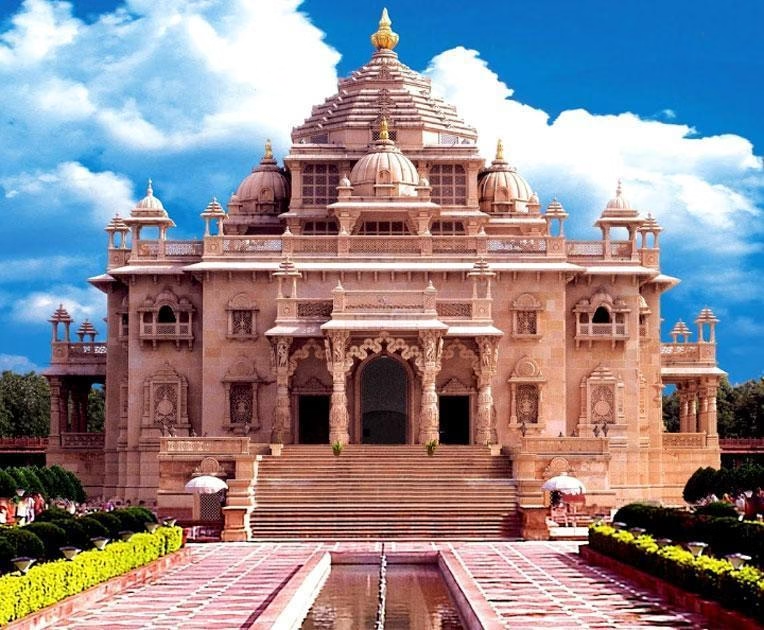
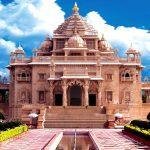
Akshardham in Gandhinagar, Gujarat, is a sanctuary of devotion, artistry, and peace. Officially known as the Swaminarayan Akshardham, this complex is not merely a structure of stone but a living tribute to the life and philosophy of Bhagwan Swaminarayan. Inspired by Yogiji Maharaj, the fourth spiritual successor of Bhagwan Swaminarayan, and constructed under the guidance of Pramukh Swami Maharaj, the temple serves as a profound spiritual anchor for millions.
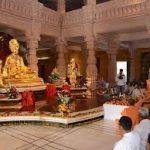
Primary Deity & Form: The central Murti (idol) is a seven-foot-tall, gold-leafed figure of Bhagwan Swaminarayan. He is worshipped as God Almighty (Parabrahma). The idol is accompanied by the Murtis of Aksharbrahma Gunatitanand Swami and Aksharmukta Goplanand Swami, representing the concept of the ideal devotee and the eternal abode.
Phalaśruti (Spiritual Benefits): Devotees visit Akshardham to experience Shanti (peace) and Anand (bliss). According to the BAPS philosophy, a visit to Akshardham is a step toward Moksha (liberation). The complex is designed to cleanse the mind and soul, allowing visitors to witness the harmony between the divine and the earthly. It is a place where ancestral karma is believed to be pacified through the darshan of the divine architect.
Historical Origins & Scriptural Legend
Construction & Modern Heritage: Unlike ancient structures dating back centuries, Akshardham Gandhinagar is a monument of modern India, yet it is built entirely on ancient Vedic principles. The foundation stone was laid in 1979, and the temple was inaugurated on November 2, 1992. It took 13 years of dedicated labor by thousands of artisans to complete.
Scriptural & Sthala Purana: While the Gandhinagar complex is relatively modern, its Shthala Purana (local legend) is rooted in the deep spiritual lineage of the Swaminarayan Sampradaya. Tradition holds that the divine architecture mirrors the original Akshardham in the celestial abode of Bhagwan Swaminarayan. According to temple records and BAPS tradition, the complex serves as a timeless reminder of the teachings found in the Vedic scriptures, emphasizing the non-dualistic truth and the path of devotion.
Architectural Marvels
Akshardham Gandhinagar is a masterpiece of Nagara-style temple architecture, meticulously adapted to the BAPS aesthetic. It is a testament to the discipline of Vastu Shastra and Shilpa Shastra.
Materials and Structure: The Akshardham Mandir stands 108 feet high, 131 feet wide, and 240 feet long. It is constructed entirely from 6,000 metric tons of pink sandstone quarried from Rajasthan. Crucially, no steel or iron is used in the load-bearing structure. Instead, massive stone beams—each weighing five tons—provide support.
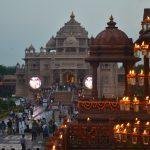
Exterior Details: The Shikhara (dome) and the surrounding Mandapas (halls) are adorned with 97 carved pillars, 17 domes, 8 balconies, and 264 sculpted figures. Every pillar and archway depicts scenes from Hindu epics, flora, and fauna, representing the divine creation.
Interior Sanctum: The central chamber houses the Murti of Bhagwan Swaminarayan. The first floor, the Vibhuti Mandapam, displays lotus-shaped exhibits detailing the spiritual greatness of the Lord. The basement, the Prasadi Mandapam, houses historical relics and sacred artifacts.
Darshan & Ritual Logistics
To ensure a serene experience, the temple adheres to a structured schedule. Below are the estimated timings for 2026. Please verify locally on the day of your visit.
| Session | Timings | Notes |
|---|---|---|
| Morning Darshan | 09:30 AM – 12:00 PM | First entry at 09:15 AM |
| Afternoon Break | 12:00 PM – 3:30 PM | Temple closed for maintenance |
| Evening Darshan | 3:30 PM – 7:30 PM | Last entry at 7:00 PM |
Key Sevas (Rituals):
- Abhishekam: A ceremonial bathing of the idol with milk, honey, and ghee. Timings: 9:00 AM (requires prior booking).
- Archana: Recitation of holy names. Can be performed in the Sameti (compound) area.
- Arti: Performed during the morning and evening transitions.
Online Seva Booking: For devotees wishing to book specific Sevas or participate in the Abhishek, the official BAPS website (baps.org) handles registrations. It is recommended to book at least 48 hours in advance, especially for the Sahran Shravan Maas or Diwali festivals.
Major 2026 Festival Dates:
- Navratri: September 21 – October 1, 2026 (Grand cultural programs and decorative themes).
- Diwali & New Year (Vikram Samvat 2083): October 18 – 23, 2026 (Special Annakut offering).
- Maha Shivaratri: February 26, 2026 (Evening Arti and devotional singing).
Practical Visitor Guidance
Dress Code & Etiquette: Modesty is paramount. Visitors are required to wear traditional Indian attire (Saree, Kurta-Pajama, Dhoti) or formal Western clothing. Shorts, skirts above the knee, and sleeveless tops are strictly prohibited.
Photography & Electronics: Photography is allowed in the garden and exterior areas but strictly prohibited inside the main Mandir and the Cultural Complex. Mobile phones, cameras, and electronic devices must be deposited in the free locker facilities provided at the entrance.
Crowd Management & Accessibility:
- Best Hours: Weekday mornings (Tuesday–Friday) are the least crowded. Weekend evenings see heavy footfall.
- Seasonal Advice: Summers (April–June) in Gandhinagar are hot; carry a reusable water bottle (filtered water is available at stations). The temple complex is air-conditioned.
- Accessibility: The entire complex is wheelchair accessible with ramps and elevators.
Pilgrimage Connectivity
How to Reach Akshardham:
- Nearest Airport: Sardar Vallabhbhai Patel International Airport (AMD), Ahmedabad. Distance: 25 km (approx. 45 mins via NH 848).
- Nearest Railway Station: Gandhinagar Capital Railway Station (GNC). Distance: 4 km.
- By Road: Located on J Road in Sector 20, the temple is well-connected via the Ahmedabad-Gandhinagar Highway (State Highway 41).
Nearby Sacred Sites:
- Hadmatia Hanuman Temple: Located 5 km away, known for its unique Hanuman idol and tranquil riverfront setting.
- Ambaji Temple: Located approximately 65 km north (in the Arasuri Hills), this is a Shakti Peeth and a major pilgrimage destination in Gujarat.
- Adalaj Stepwell (Adalaj Ni Vav): Located 10 km south, this 15th-century stepwell is an architectural marvel and a spiritual resting point.
Frequently Asked Questions (FAQ)
Is there a VIP darshan entry?
There is no commercial VIP ticket system. However, devotees who have booked specific Sevas (like Abhishekam) in advance are given priority entry through a designated gate. For general darshan, entry is free for all on a first-come, first-served basis.
What is the significance of the Akshardham Mandir structure?
The structure is designed to represent the eternal home of God (Akshardham). The 108-foot height is numerically significant in Vedic culture, representing the 108 beads of a Japa Mala and the 108 directions in space.
Are outside food and water bottles allowed?
No, outside food and beverages are not permitted inside the complex. However, the campus houses a clean and hygienic Bhojanalaya (dining hall) that serves simple vegetarian Prasad/meal at a nominal cost.
What is the difference between Akshardham Delhi and Akshardham Gandhinagar?
Both were built by BAPS and follow similar architectural styles. Gandhinagar Akshardham is older (inaugurated in 1992) and is generally quieter than the Delhi complex. The Gandhinagar Mandir is built entirely of stone, whereas the Delhi complex incorporates modern technology in its exhibits.
Can foreign nationals visit the temple?
Yes, Akshardham welcomes visitors from all nationalities and faiths. Passport verification is required at the entry for foreign nationals.




Recent Posts

Mere Satguru Ne Di Thi Davai Lyrics in Hindi & Meaning
Mere Satguru Ne Di Thi Davai: Invoking the Guru’s Liberating Wisdom This soul-stirring bhajan venerates the Satguru (True Spiritual Master) as the divine physician who dispenses the only remedy for life’s deepest sufferings. Composed by Sant Karmaveer Tufani, it…

Janm Diyo Thari Maa Dukh Dekhiyo Lyrics in Hindi & Meaning
जन्म दियो थारी माँ दुख देखियो (Maa’s Grief Upon Birthing You) This soul-stirring Chetavani Bhajan (admonitory hymn) is addressed to the Divine Mother (Maa) – a call for repentance when children forget their filial duties in the dark age…
Bhadi Sabha Mein Thane Manaun Lyrics in Hindi & Meaning
Bhadi Sabha Mein Thane Manaun: Invoking the Spear-Wielding Mother Mata Bhawani (श्री ज्वाला भवानी), the fiery manifestation of Shakti worshipped as the Protector of Dharma in Her Dhaulagarh sanctum. Origin & Spiritual Essence Composed in Rajasthani folk tradition by…

श्याम सुन्दरवा छोटे छोटे कनुवा Lyrics & Meaning
श्याम सुन्दरवा छोटे छोटे कनुवा (Shyam Sundarva Chhote Chhote Kanuva) is a heartfelt invocation to Lord Krishna in his most enchanting form—Shyam Sundar (the dark, beautiful one). This bhajan is a plea for the divine child Kanha to grace…
Maat Meri Chintapurni Lyrics in Hindi & Meaning
Maat Meri Chintapurni is a heartfelt devotional prayer dedicated to Maa Chintapurni, a form of the Divine Mother. She is revered as the remover of worries and the granter of wishes, especially venerated in the Himalayan region of Himachal…

थारी रे नदियां का ढावा पे खीची राजा Lyrics & Meaning
खीची राजा का अद्भुत युद्ध: एक शौर्य गाथा यह भजन एक पौराणिक या ऐतिहासिक शूरवीर राजा की वीरता का वर्णन करता है, जो प्रायः गुजराती लोक संस्कृति में लोककथाओं का हिस्सा है। इसकी रचना दुर्गेश कटारा ने की है…
बेगो बेगो चाल श्याम सिंगोली बुलावे रे Lyrics in Hindi & Meaning
Bhajan Title & Deity This bhajan, बेगो बेगो चाल श्याम सिंगोली बुलावे रे, is dedicated to Lord Shyam, a revered form of Lord Krishna. Origin & Spiritual Essence The composer of this bhajan is not specified, but it is…
सिंगोली रा श्याम पधारो Lyrics in Hindi & Meaning
सिंगोली रा श्याम पधारो Bhajan & Deity This sacred bhajan, सिंगोली रा श्याम पधारो, is dedicated to Lord Shyam, a revered deity in the Hindu tradition. The composer of this bhajan is Dev Sharma Aama. Origin & Spiritual Significance…

हंसकर पार्वती शिव जी ने वचन सुनावती जी Lyrics in Hindi & Meaning
हंसकर पार्वती शिव जी ने वचन सुनावती जी – A Devotional Bhajan Origin & Spiritual Significance This beautiful bhajan, हंसकर पार्वती शिव जी ने वचन सुनावती जी, is a heartfelt devotion to Lord Shiva and Goddess Parvati, embodying the…

ज्ञान सतगुरु समझायो ए Lyrics in Hindi & Meaning
This bhajan, ज्ञान सतगुरु समझायो ए, is dedicated to the revered deity, Shyam, and is a testament to the transformative power of spiritual guidance. The composer of this bhajan is unknown, but it is deeply rooted in the Rajasthani…