Chakresvara Temple & Tank History: Darshan Timings, Legend & Guide
Receive daily temple updates, divine darshan, and morning bhajans directly on WhatsApp.
Contents
Chakresvara Temple: A Definitive Pilgrimage Guide to Bhubaneswar’s Hidden Gem
Introduction & Spiritual Essence
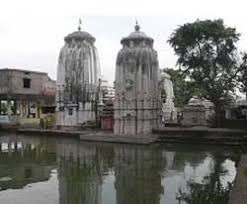
Located in the spiritual heart of Odisha, the Chakresvara Temple, accompanied by the historic Chakresvara Tank, stands as a serene testament to devotion and architectural heritage in Bhubaneswar. While often overshadowed by larger monuments, this site offers a profound connection to the sacred geography of the city. The primary deity is Lord Shiva, worshipped here as Chakresvara.
Phalaśruti: Why Devotees Visit
In local tradition, tanks (pokharis) adjacent to temples are considered sacred extensions of the temple itself, often representing the Sarovara (holy pond) mentioned in temple lore. Devotees believe that circumambulating the tank and offering prayers at Chakresvara Temple aids in cleansing ancestral karma (Pitra Dosha) and bestows mental clarity and spiritual purity. The natural spring feeding the tank is regarded as a self-manifested (Swayambhu) source of divine energy.
Historical Origins & Scriptural Legend
Dating and Builders
While the temple complex in the Hatiasuni lane exhibits the grandeur of earlier centuries, historical records and the physical structure of the adjoining tank place its significant construction or major renovation in the early part of the 20th century A.D. The site is deeply entrenched in the cultural fabric of the region, maintained traditionally by local families.
Scriptural References & Sthala Purana
According to temple records and local oral legends (Stothala Purana), the site was originally envisioned by the saintly figure Chakreshvara Mahanta. Tradition holds that the natural spring feeding the tank is inexhaustible, a phenomenon attributed to a subterranean connection with the sacred waters of the Ganges, thus sanctifying the site for daily worship and rituals.
📖 Related: Sarala Temple, Jagatsinghpur: History, Darshan Timings & Guide (2026)
Architectural Marvels
The Chakresvara complex exemplifies the elegance of Kalingan Style (Kalinga Architecture), indigenous to Odisha.
The Tank
The tank is square on plan, featuring robust laterite embankments. Its unique engineering allows it to be fed by a natural spring, maintaining a constant water level year-round. An outlet channel in the southwest corner regulates discharge, showcasing ancient hydraulic engineering principles.
The Temple
While the provided data highlights the tank, the accompanying Chakresvara Temple in Hatiasuni lane follows the classic Rekha Deula style typical of Odishan temples. The structure comprises a sanctum (Garbhagriha) and a boundary wall, adorned with traditional sculptures. The temple is situated to the northeast of the tank, aligning with Vastu Shastra principles where the water element is positioned to harness positive energy.
Although the specific ASI (Archaeological Survey of India) listing status for this specific structure is not explicitly noted as a national monument in the provided context, its architectural integrity makes it a significant heritage asset of Bhubaneswar.
Darshan & Ritual Logistics
Chakresvara Temple operates on traditional timings, though specific seasonal adjustments may apply. Below is a general schedule for 2026.
| Session | Timing | Details |
|---|---|---|
| Morning Darshan | 06:00 AM – 12:00 PM | Morning Aarti and regular Pooja. |
| Mid-day Closure | 12:00 PM – 04:00 PM | Temple remains closed for rituals. |
| Evening Darshan | 04:00 PM – 08:00 PM | Evening Aarti and lamp offering. |
| Special Days | Sundays & Festivals | Timings extended by 1-2 hours. |
Key Sevas (Services)
– Abhishekam: Ritual bathing of the Shiva Linga (usually performed on Mondays and Maha Shivaratri).
– Archana: Recitation of names (Namakam/Chamakam).
– Rudra Abhishekam: A comprehensive Vedic ritual for prosperity.
📖 Related: Dutikeswar Mahadev Temple, Nayagarh
Online Booking
As this is a local heritage temple, major online portals may not list it. Devotees are advised to contact the temple trust or local priest directly for advanced booking of Sevas. For major festivals, physical presence is typically required.
2026 Major Festival Dates
– Maha Shivaratri: February 26, 2026
– Ratha Yatra (Jagannath Temple proximity): June 27, 2026
– Diwali (Kartik Amavasya): November 1, 2026
– Shivaratri (Monthly): Every Monday and Trayodashi.
Practical Visitor Guidance
Dress Code & Etiquette
Visitors should dress modestly. Traditional Indian attire is recommended. Leather items are traditionally prohibited in the inner sanctum. Silence should be maintained near the tank area.
Photography & Lockers
Photography is generally permitted in the outer complex and tank area but restricted inside the sanctum (Garbhagriha). Mobile lockers are not available on-site; visitors should travel light.
Accessibility
The temple is located in a residential lane (Hatiasuni lane). While accessible, the narrow lanes may pose challenges for wheelchairs. It is advisable to park vehicles near Tankapani Road and walk the remaining distance.
Crowd Management & Seasonal Advice
– Best Hours: Early mornings (6:00 AM – 8:00 AM) are best for a peaceful darshan.
– Summer (May): Bhubaneswar gets hot; carry water and an umbrella.
– Monsoon: The laterite steps can be slippery; exercise caution.
Pilgrimage Connectivity
How to Reach
– Nearest Airport: Biju Patnaik International Airport (BBI) – Approx. 5 km (15-20 mins).
– Nearest Railway Station: Bhubaneswar Railway Station (BBS) – Approx. 3 km (10-15 mins).
– Road Access:
– From Bhubaneswar Railway Station: Take Janpath Road, connect to Tankapani Road.
– Landmark: Rajarani Colony, branching from Tankapani Road. Look for the entrance of Hatiasuni lane near the Rajarani Temple intersection.
📖 Related: Patali Srikhetra Temple History & Darshan Timings: Complete 2026 Guide
Nearby Sacred Sites (Pilgrimage Circuit)
1. Rajarani Temple (0.5 km): Known for its intricate carvings and unique idol of Lord Brahma.
2. Mukteswar Temple (2 km): A gem of Odishan architecture, famous for its torana (archway) and arched windows.
3. Lingaraj Temple (4 km): The largest and most ancient temple in Bhubaneswar, dedicated to Lord Shiva.
Frequently Asked Questions (FAQ)
**1. What is the primary deity at Chakresvara Temple?
**
The primary deity is Lord Shiva, worshipped as Chakresvara. The complex is also known for the sacred Chakresvara Tank.
**2. Is there a VIP or special entry darshan available?
**
As a local heritage temple, there is typically no formal VIP entry system. However, elderly devotees or those wishing to perform specific rituals may seek assistance from the temple priest for priority access.
**3. What is the historical significance of the tank?
**
The tank dates back to the early 20th century and is unique for being fed by a natural spring. It is historically linked to Chakreshvara Mahanta and serves as a vital water source for the surrounding community, representing the Kalingan tradition of integrating water bodies with temple architecture.
**4. Is there an entry fee?
**
No, there is no entry fee for darshan. Donations are accepted voluntarily.
**5. What is the best time to visit Bhubaneswar for this pilgrimage?
**
The ideal months are October to March when the weather is pleasant and cool, avoiding the summer heat and heavy monsoons.
**6. Is Chakresvara Temple near Rajarani Temple?
**
Yes, Chakresvara Tank is situated to the southwest of the Rajarani Temple complex, making them accessible within the same locality.
250px-KotitirthaTank, Chakresvara Tank, Bhubaneswar, Odisha
330px-KukutesvaraTank, Chakresvara Tank, Bhubaneswar, Odisha
download, Chakresvara Tank, Bhubaneswar, Odisha