

Contents
Introduction & Spiritual Essence
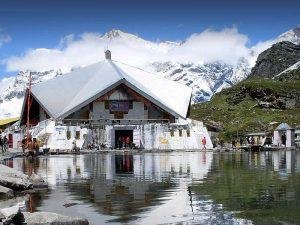
Perched at an ethereal altitude of 4,632 meters (15,197 feet) amidst the snow-capped peaks of the Himalayas, Hemkund Sahib (also spelled Hemkunt) stands as a singular confluence of Sikh and Hindu faith. The name derives from ‘Hem’ (Snow) and ‘Kund’ (Bowl), describing the glacial lake that sits serenely in this high-altitude basin. It is a place where the air thins, but spiritual intensity thickens.
Primary Deities & Entities:
- Guru Gobind Singh Ji: The tenth Sikh Guru, whose presence is enshrined in the Gurudwara Shri Hemkund Sahib Ji.
- Lakshmana: The younger brother of Lord Rama, venerated at the Lakshmana Temple situated on the banks of the lake.
Phalaśruti (Spiritual Benefits):
Devotees undertake this arduous trek not merely for sightseeing, but for cleansing ancestral karma and seeking Mukti (liberation). For Sikhs, it is the site of the Guru’s Bhakti in a previous birth; for Hindus, it is where Lakshmana regained vitality after the war with Ravana. The crisp mountain air and the reflective waters of the Lokpal Lake are believed to facilitate deep meditation and self-realization.
Historical Origins & Scriptural Legend
The history of Hemkund is a tapestry woven from two distinct yet harmonious threads of tradition.
The Sikh Tradition: Dasam Granth
According to the Dasam Granth, a scripture dictated by Guru Gobind Singh Ji himself, the Guru meditated at this sacred site during a previous incarnation. He writes of a place surrounded by seven snow-capped peaks, known as Sapt Shring. In the 20th century, Sant Sohan Singh and Hawildar Moan Singh, guided by these scriptural descriptions, identified the precise location. The Hemkunt Trust was subsequently established in 1959 to develop the infrastructure for pilgrims.
The Hindu Tradition: The Ramayana
Local Sthal Purana (oral legends) identifies Hemkund as Pushpavati or Indra Lake. It is deeply revered in the Ramayana. Tradition holds that after the great war with Ravana, Lakshmana was severely injured by Indrajeet’s Nagpaash (serpent noose). To revive him, Hanuman brought the Sanjeevani herb. However, Lakshmana meditated on the banks of this lake to regain his full health and strength, making it a site of healing energy.
Architectural Marvels & Vastu
While the architecture here is dictated more by the brutal Himalayan environment than classical temple canons, the structures are marvels of modern engineering and spiritual symbolism.
The Gurudwara
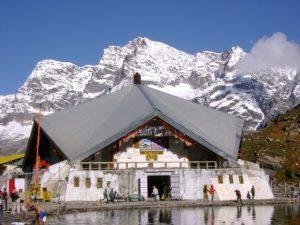
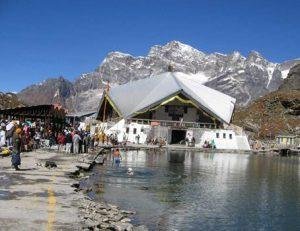
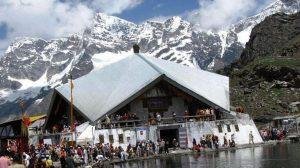
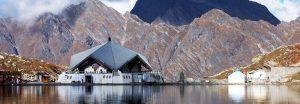
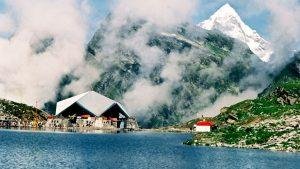
The Gurudwara Shri Hemkund Sahib Ji features a distinctive Gumbaz (dome) clad in white tiles, reflecting the surrounding glaciers. Built on a large rock projection over the Lokpal Lake, its Vastu orientation aligns perfectly with the rising sun over the Hathi Parvat peak. The intricate Jali (lattice) work and the pristine white exterior stand as a symbol of purity against the rugged grey rocks.
The Lakshmana Temple
Built by the Hemkunt Trust in 1984, this stone temple adheres to North Indian (Nagara) style aesthetics. It is compact, designed to withstand high winds and heavy snowfall. The Shikhara (spire) is modest yet elegant, housing a beautiful Murti (idol) of Lakshmana in a meditative posture.
Natural Setting
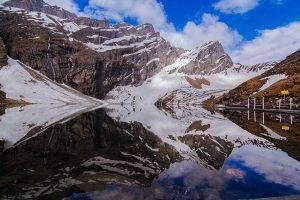
The seven peaks surrounding the lake—known as the Sapt Rishi peaks—create a natural amphitheater. The architecture here is the Vastu Purusha Mandala of nature itself, with the lake serving as the central Brahmasthan.
Darshan & Ritual Logistics (2026 Season)
The pilgrimage season for Hemkund Sahib typically runs from May to October, as the lake remains frozen in winter.
Daily Timings
Note: Timings are subject to weather conditions and daylight availability at high altitude.
| Segment | Timing |
|---|---|
| Opening (Gurdwara) | 05:00 AM (From Ghangaria) |
| Morning Darshan | 06:00 AM – 12:00 PM |
| Afternoon Break | 12:00 PM – 01:00 PM |
| Evening Darshan | 01:00 PM – 05:00 PM |
| Closing | 05:30 PM (Return to Ghangaria) |
Key Sevas & Booking
- Ardas (Prayer): Performed continuously throughout the day.
- Shri Sukhmani Sahib Path: Daily recitations.
- Langer (Community Meal): Available at Ghangaria and near the shrine (subject to weather).
- Online Seva: Devotees can register for special prayers or donation drives via the official Hemkunt Trust website (hemkunt.org). Note: Physical presence is required for the trek; bookings are primarily for accommodations at base camps.
2026 Major Festivals
- Guru Gobind Singh Ji’s Prakash Utsav: January 5, 2026 (Celebrated at the base camp/Shri Hemkund Sahib Gurdwara).
- Opening Ceremony: May 25, 2026 (Tentative date based on snowmelt).
- Guru Nanak Dev Ji’s Gurpurab: November 5, 2026 (Closing ceremony often coincides with this date).
Practical Visitor Guidance
Hemkund is a high-altitude wilderness zone. Strict discipline is required.
Dress Code & Etiquette
At the Gurudwara, a head cover is mandatory (scarves are available for rent). Modest clothing covering shoulders and knees is required for both the Gurudwara and the Lakshmana Temple. Shoes must be removed at the designated drop-off point before the final ascent.
Photography & Electronics
Photography is strictly prohibited inside the sanctum sanctorum of the Gurudwara. Mobile phones are allowed but should be on silent mode. Lockers are available at Ghangaria (the base camp) for valuables, as carrying heavy bags on the trek is discouraged.
Crowd Management & Seasons
- Best Hours: Start the trek from Ghangaria by 4:00 AM to reach Hemkund by 7:00 AM. This avoids the midday heat and afternoon crowds.
- May/June: Pleasant weather, but expect snow patches near the lake.
- July-August: Monsoon season; risk of landslides on the approach road. Carry rain gear.
- September/October: Crystal clear skies, best for photography.
Pilgrimage Connectivity
How to Reach
The journey involves a road trip to Govindghat followed by a trek.
- Nearest Airport: Jolly Grant Airport, Dehradun (approx. 145 km / 5-6 hrs drive to Govindghat).
- Nearest Railway Station: Rishikesh (approx. 115 km / 4-5 hrs drive).
- By Road: Govindghat is connected via NH7 (now NH7A) and the Rishikesh-Badrinath Highway. From Govindghat, a 4 km motorable road leads to Ghangaria.
- The Trek: From Ghangaria to Hemkund Sahib is a steep 6 km trek (approx. 3-4 hours one way). Ponies and palanquins are available for the physically challenged.
Nearby Sacred Sites
- Valley of Flowers National Park: Located on the same route as Hemkund (divert at Ghangaria). A UNESCO World Heritage Site.
- Badrinath Temple: One of the Char Dham, located 16 km downstream from Govindghat.
- Joshimath: The winter seat of Lord Badrinath and a gateway to Auli.
Frequently Asked Questions (FAQ)
1. Is there a VIP Darshan entry at Hemkund Sahib?
No. Hemkund Sahib follows the Sikh principle of equality. There are no VIP tickets or shortcuts. Everyone, regardless of status, must complete the 6 km trek to reach the shrine. Palanquins are available for those unable to walk due to medical reasons.
2. Is the temple open in winter?
No. Due to heavy snowfall and temperatures dropping below -10°C, the shrine remains closed from November to April. The ritual processions move to Joshimath during these months.
3. What is the altitude sickness risk?
Hemkund is at 15,197 feet. Acute Mountain Sickness (AMS) is a real risk. We recommend spending a day acclimatizing in Ghangaria (10,000 feet) before attempting the ascent. Drink plenty of water and avoid alcohol.
4. Can I carry my own food?
While plastic water bottles are discouraged (use reusable ones), dry snacks like nuts and energy bars are allowed. However, the Langar at Ghangaria and the tea stalls along the trail provide excellent refreshment.
5. Is there mobile connectivity?
Network coverage is erratic. BSNL works best in Joshimath and Ghangaria. There is usually no signal at Hemkund Sahib, allowing for a truly disconnected spiritual experience.

Recent Posts

Shri Kaamkoteeshwar Mandir, Varanasi – History & Significance
In the heart of Kashi, the eternal city of Lord Shiva, where the Ganges flows with celestial grace, stands the Shri Kaamkoteeshwar Mandir. This sacred Sannidhi is not merely a temple but a profound spiritual bridge between the Northern…

ओ सांवरे तूने ही मुझको संभाला – Lyrics & Meaning
ओ सांवरे तूने ही मुझको संभाला – A Prayer to Shyam Origin & Spiritual Essence Why This Bhajan Resonates Devotees chant this when overwhelmed by life’s storms—the refrain ‘तूने ही मुझको संभाला’ is the soul’s sigh of relief: “You…

कथा ये है महाराज मेरे की – Lyrics & Meaning
कथा ये है महाराज मेरे की छत्रपति संभाजी महाराज – A Prayer to Chhatrapati Sambhaji Maharaj Origin & Spiritual Essence Why This Bhajan Resonates Devotees chant this when their spirit feels tested—its powerful refrain “महाराज मेरे” is a soul’s…

Rigveda Samhita Yathartha Anuvada (ऋग्वेद संहिता यथार्थ अनुवाद) – Complete Set with Anvayartha & Hindi/English Translation
The Rigveda is the oldest surviving scripture of humanity and the foundational text of Sanātana Dharma. For serious students, scholars, UPSC aspirants studying ancient Indian history, Sanskrit learners, and spiritual seekers, a precise and grammatically structured translation is indispensable.…

आना भी अकेला है जाना भी अकेला है – Lyrics & Meaning | BharatTemples
आना भी अकेला है जाना भी अकेला है – A Prayer to the Divine Witness Origin & Spiritual Essence Why This Bhajan Resonates Devotees turn to this bhajan in moments of deep reflection—when life’s attachments begin to ache. The…

माता शेरावाली के द्वार जो भी जाता है – Lyrics & Meaning
माता शेरावाली के द्वार जो भी जाता है – A Prayer to Maa Sherawali Origin & Spiritual Essence Why This Bhajan Resonates Devotees turn to this bhajan in times of fear or uncertainty—its promise that no one leaves Maa’s…

मार लेना सपणी उबार लेणा भवरा – Lyrics & Meaning
मार लेना सपणी उबार लेणा भवरा – A Prayer to the Divine Beloved Origin & Spiritual Essence Why This Bhajan Resonates Devotees chant this in moments of deep vulnerability—its cry of “मार लेना सपणी, उबार लेणा भवरा” is the…

हमें श्याम सुंदर भरोसा तुम्हारा – Lyrics & Meaning
हमें श्याम सुंदर भरोसा तुम्हारा – A Prayer to Shyam Sundar Origin & Spiritual Essence Why This Bhajan Resonates Devotees chant this when feeling alone—its refrain ‘de do sahara’ is the soul’s cry for divine support. Lyrics in Hindi…

Mere Satguru Ne Di Thi Davai Lyrics in Hindi & Meaning
Mere Satguru Ne Di Thi Davai: Invoking the Guru’s Liberating Wisdom This soul-stirring bhajan venerates the Satguru (True Spiritual Master) as the divine physician who dispenses the only remedy for life’s deepest sufferings. Composed by Sant Karmaveer Tufani, it…

Janm Diyo Thari Maa Dukh Dekhiyo Lyrics in Hindi & Meaning
जन्म दियो थारी माँ दुख देखियो (Maa’s Grief Upon Birthing You) This soul-stirring Chetavani Bhajan (admonitory hymn) is addressed to the Divine Mother (Maa) – a call for repentance when children forget their filial duties in the dark age…