
Contents
- 1 Introduction & Spiritual Essence: The Peacock Grove of Shiva
- 2 Historical Origins & Scriptural Legend
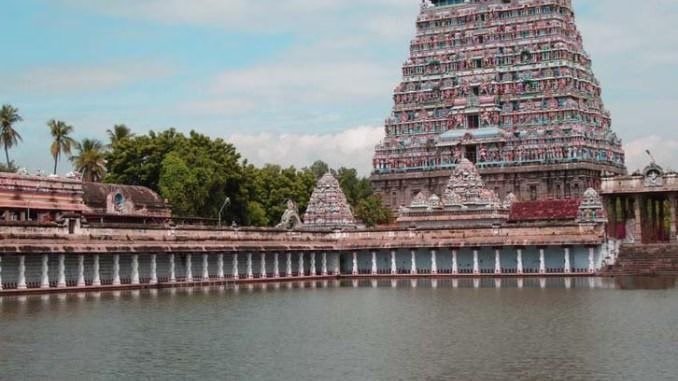
- 3 Architectural Marvels: Dravidian Grandeur
- 4 Darshan & Ritual Logistics (2026 Guide)
- 5 Practical Visitor Guidance
- 6 Pilgrimage Connectivity
- 7 Contact Details
Introduction & Spiritual Essence: The Peacock Grove of Shiva
Deep within the bustling heart of Chennai lies a spiritual oasis that echoes with the chants of the Nayanars and the rustle of ancient palms—the Kapaleeshwarar Temple in Mylapore. This is not merely a monument of stone; it is a Paadal Petra Sthalam, glorified in the 7th-century Tamil Saiva canonical work, the Tevaram. The primary deity, Lord Shiva, is worshipped here as Kapaleeshwarar (derived from Kapala meaning skull and Ishwara meaning Lord), appearing as a Swayambhu Lingam. His consort, Parvati, is venerated as Karpagambal—the Goddess of the Wish-Yielding Tree.
Phalaśruti: The Spiritual Benefits
Devotees flock to Kapaleeshwarar Temple seeking liberation from sins and the removal of malefic planetary influences, particularly those associated with Shani (Saturn). According to the Sthala Purana, worshipping Karpagambal grants boons and spiritual fulfillment. A unique aspect here is the cleansing of ancestral karma; it is believed that performing rituals for forefathers at this temple liberates their souls, as the divine energy of the Peacock (Mayil)—the vahana of Lord Murugan—resides here, symbolizing the destruction of poisonous ignorance (evil).
Historical Origins & Scriptural Legend
The Legend of the Peacock and the Skull
Tradition holds that the very soil of Mylapore (from Mayil meaning peacock) is sanctified by a divine past. Legend narrates a meeting between Lord Brahma and Lord Shiva atop Mount Kailash. Brahma, overwhelmed by pride, failed to offer due respect to Shiva. In a display of cosmic justice, Shiva plucked one of Brahma’s five skulls (Kapalam). To absolve this sin, Brahma descended to this spot in South India and installed a Lingam to please Shiva.
A parallel legend involves Goddess Parvati. Desiring to witness the primal energy of the Rudra Yagna, she was cursed by Shiva to take the form of a peahen. She performed intense penance here to regain her original form, establishing the temple’s name and the sacred tank (Theertham) as the site of purification.
Archaeology and Dynastic Patronage
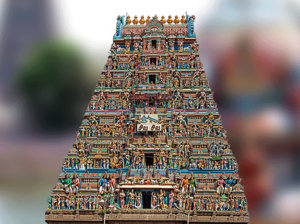
While hymns of the Tevaram (7th century CE) suggest the temple existed during the Pallava era—positioning it near the seashore as the coastline has shifted over centuries—the current masonry structure largely reflects the grandeur of the Vijayanagara Empire. Specifically, the rulers of the Tuluva Dynasty (1491–1570 CE) commissioned significant expansions. The towering Gopuram (gateway tower) was constructed in 1906 by renowned sthapathis (architects), replacing older structures while preserving the sanctity of the original shrines. The temple is currently maintained by the Hindu Religious and Endowment Board of the Government of Tamil Nadu.
Architectural Marvels: Dravidian Grandeur
The temple is a quintessential example of Dravidian Architecture, characterized by its imposing Gopurams and intricate stucco work. The layout follows the principles of Vastu Shastra, with the sanctum sanctorum located in the southwest corner.
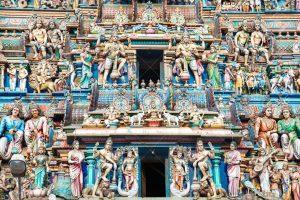
- The Eastern Gopuram: Rising approximately 40 meters (120 ft), this towering gateway is adorned with colorful statues depicting myths from the Puranas. It serves as the primary entrance and faces the vibrant flower market.
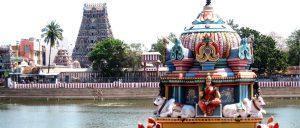
- The Western Gopuram: Smaller in stature, this gateway faces the sacred Nandi Theertham (temple tank). It is believed that the Goddess chose to manifest herself near this water source.
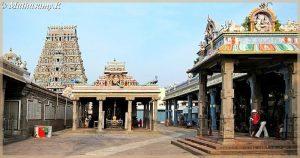
- Sanctum Layout: The temple complex houses numerous shrines. The inner courtyards feature pillared Mandapas (halls) with monolithic columns. A unique feature is the shrine of Dakshinamurthy (Shiva as a teacher), which is located in the outermost prakaram (circumambulatory path), a rare architectural placement.
- Symbolism: Inside the temple, you will find a caged peacock and peahen. This is a living symbol of the legend where Karpagambal manifested as a peahen to plead with Kapaleeshwarar. The Vahanas (divine vehicles) used during processions include the Bull (Nandi), Elephant, Peacock, Goat, and Parrot.
Darshan & Ritual Logistics (2026 Guide)
The temple follows a rigorous schedule of six daily rituals. Below are the general timings for 2026. Please note that timings may vary slightly during festival seasons.
| Ritual / Session | Timing (IST) | Details |
|---|---|---|
| Ushathkalam | 5:00 AM – 6:00 AM | Morning ablutions and first opening of the sanctum. |
| Kalasanthi | 6:00 AM – 8:00 AM | Standard Darshan and Morning Pooja. |
| Uchikalam | 12:00 PM – 1:00 PM | Noon ritual; ideal for Abhishekam bookings. |
| Sayarakshai | 4:00 PM – 6:00 PM | Evening Darshan begins. |
| Rajakalam | 6:00 PM – 8:00 PM | Peak evening hours; lamps are lit. |
| Arthajamam | 8:00 PM – 10:00 PM | Closing rituals; last darshan. |
Key Sevas and Booking
Devotees can book Sevas (ritual services) online via the official Tamil Nadu HR&CE portal. Key offerings include:
- Abhishekam: Ritual bathing of the Lingam (usually performed with milk, honey, sandalwood paste).
- Archana: Chanting of names (can be done in Tamil, Telugu, Sanskrit, or Hindi).
- Kalabhairava Homam: Performed on Saturdays to ward off fear and negative energy.
- Special Darshan: A fast-track ticket for bypassing the general queue (₹50–₹100).
2026 Major Festivals
- Arubathimooval Festival (Panguni Uthiram): (March/April 2026) The most spectacular 10-day festival. The chariot procession (Ther) of Kapaleeshwarar and Karpagambal is the highlight. Lakhs of devotees gather for the final day.
- Karthigai Deepam: (November/December 2026) Illumination of the temple with thousands of lamps.
- Aadi Perukku: (July/August 2026) Special abhishekam at the temple tank.
Practical Visitor Guidance
- Dress Code: Traditional attire is mandatory. Men should wear Dhoti or formal trousers with a shirt; Women should wear Saree, Salwar Kameez, or full-length skirts. Avoid jeans and shorts.
- Photography & Mobiles: Photography is strictly prohibited inside the inner sanctum. Mobile phones should be silenced. Lockers are available near the entrance for electronic devices.
- Accessibility: The temple has steps at the entrance. However, ramp facilities are available near the western entrance for elderly devotees. Wheelchairs can be arranged upon request at the administration office.
- Crowd Management: The temple is extremely crowded on Mondays (Somvar) and during festival days.
Best time to visit: Weekday mornings (7:00 AM – 9:00 AM) or late evenings after 8:00 PM. Tip: Carry a water bottle and wear light cotton clothes during May (summer peak) as the queue lines are exposed to the sun.
Pilgrimage Connectivity
Located in the bustling neighborhood of Mylapore, the temple is well-connected by all modes of transport.
- By Air: Chennai International Airport (MAA) is approximately 18 km away. Prepaid taxis and Metro rail (Green Line to MRTS Station/Mylapore) are the most efficient options.
- By Rail: The nearest suburban rail station is Mylapore (MYP) on the Chennai Beach – Tambaram line. Chennai Central (MAS) and Egmore (MSB) are major terminals 5–7 km away.
- By Road: The temple is easily accessible via Dr. Radhakrishnan Salai (formerly Boat Club Road) and Annamalai Road. City buses (MTC) frequently ply to the “Mylapore Tank” terminus.
Nearby Sacred Sites (Pilgrimage Circuit)
- Kabaleeswarar Temple (Santhome): Just 1 km away, this historic church stands on the tomb of St. Thomas, reflecting Chennai’s multi-religious harmony.
- Sri Parthasarathy Temple (Triplicane): A 2 km journey to the east leads to this ancient Vaishnavite temple dedicated to Lord Krishna, another jewel of the Mylapore-Triplicane belt.
- Marundeeswarar Temple (Tiruvanmiyur): Located 6 km south, this temple is dedicated to Shiva as the healer of ailments (Vaidyanathar).
Frequently Asked Questions (FAQ)
1. Is there a VIP or Special Darshan entry?
Yes, the temple administration offers a “Special Darshan” ticket (priced at approximately ₹50–₹100). This allows devotees to enter through a separate queue, significantly reducing wait times. VIP passes are generally reserved for officials or can be booked via local representatives.
2. What is the history behind the temple tank (Nandi Theertham)?
According to legend, Goddess Karpagambal emerged from the tank’s lotus flowers to bless devotees. While the tank was once connected to the sea (allowing temple boats to launch), it is now a freshwater source used for ritual purification and the annual Aadi Perukku festival.
3. Can I perform the last rites (Shraddha) for my ancestors here?
Absolutely. Kapaleeshwarar Temple is a highly revered site for Pinda Pradhanam (offering rice balls to ancestors). It is believed that Lord Brahma performed penance here to free himself from the sin of killing a Brahmin (Brahmahatya Dosha), making it potent for ancestral liberation.
4. How far is the sea from the temple?
While the temple is now in the interior of the city, geology suggests it was originally built on the seashore. Today, the famous Mylapore Beach (Thiruvalluvar Beach) is about 1.5 km east of the temple.
5. Is online booking for Pooja mandatory?
Booking online is recommended for Archana and Abhishekam to ensure availability, especially on weekends and festivals. However, general darshan is free and does not require prior booking.
Contact Details
Official Address:
Kapaleesvarar Sannadhi Street, Vinayaka Nagar Colony, Mylapore, Chennai, Tamil Nadu 600004
Phone: 044-2464-1670
Recent Posts

Shri Kaamkoteeshwar Mandir, Varanasi – History & Significance
In the heart of Kashi, the eternal city of Lord Shiva, where the Ganges flows with celestial grace, stands the Shri Kaamkoteeshwar Mandir. This sacred Sannidhi is not merely a temple but a profound spiritual bridge between the Northern…

ओ सांवरे तूने ही मुझको संभाला – Lyrics & Meaning
ओ सांवरे तूने ही मुझको संभाला – A Prayer to Shyam Origin & Spiritual Essence Why This Bhajan Resonates Devotees chant this when overwhelmed by life’s storms—the refrain ‘तूने ही मुझको संभाला’ is the soul’s sigh of relief: “You…

कथा ये है महाराज मेरे की – Lyrics & Meaning
कथा ये है महाराज मेरे की छत्रपति संभाजी महाराज – A Prayer to Chhatrapati Sambhaji Maharaj Origin & Spiritual Essence Why This Bhajan Resonates Devotees chant this when their spirit feels tested—its powerful refrain “महाराज मेरे” is a soul’s…

Rigveda Samhita Yathartha Anuvada (ऋग्वेद संहिता यथार्थ अनुवाद) – Complete Set with Anvayartha & Hindi/English Translation
The Rigveda is the oldest surviving scripture of humanity and the foundational text of Sanātana Dharma. For serious students, scholars, UPSC aspirants studying ancient Indian history, Sanskrit learners, and spiritual seekers, a precise and grammatically structured translation is indispensable.…

आना भी अकेला है जाना भी अकेला है – Lyrics & Meaning | BharatTemples
आना भी अकेला है जाना भी अकेला है – A Prayer to the Divine Witness Origin & Spiritual Essence Why This Bhajan Resonates Devotees turn to this bhajan in moments of deep reflection—when life’s attachments begin to ache. The…

माता शेरावाली के द्वार जो भी जाता है – Lyrics & Meaning
माता शेरावाली के द्वार जो भी जाता है – A Prayer to Maa Sherawali Origin & Spiritual Essence Why This Bhajan Resonates Devotees turn to this bhajan in times of fear or uncertainty—its promise that no one leaves Maa’s…

मार लेना सपणी उबार लेणा भवरा – Lyrics & Meaning
मार लेना सपणी उबार लेणा भवरा – A Prayer to the Divine Beloved Origin & Spiritual Essence Why This Bhajan Resonates Devotees chant this in moments of deep vulnerability—its cry of “मार लेना सपणी, उबार लेणा भवरा” is the…

हमें श्याम सुंदर भरोसा तुम्हारा – Lyrics & Meaning
हमें श्याम सुंदर भरोसा तुम्हारा – A Prayer to Shyam Sundar Origin & Spiritual Essence Why This Bhajan Resonates Devotees chant this when feeling alone—its refrain ‘de do sahara’ is the soul’s cry for divine support. Lyrics in Hindi…

Mere Satguru Ne Di Thi Davai Lyrics in Hindi & Meaning
Mere Satguru Ne Di Thi Davai: Invoking the Guru’s Liberating Wisdom This soul-stirring bhajan venerates the Satguru (True Spiritual Master) as the divine physician who dispenses the only remedy for life’s deepest sufferings. Composed by Sant Karmaveer Tufani, it…

Janm Diyo Thari Maa Dukh Dekhiyo Lyrics in Hindi & Meaning
जन्म दियो थारी माँ दुख देखियो (Maa’s Grief Upon Birthing You) This soul-stirring Chetavani Bhajan (admonitory hymn) is addressed to the Divine Mother (Maa) – a call for repentance when children forget their filial duties in the dark age…